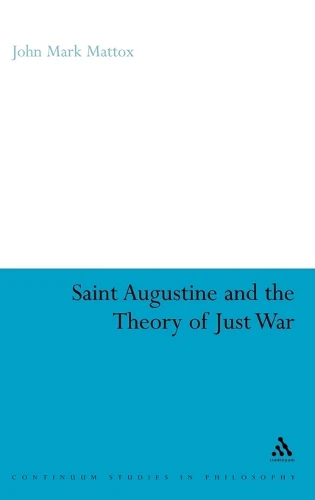
St. Augustine and the Theory of Just War: 63 (Continuum Studies in Philosophy
Provides a study that identifies the fundamental Augustinian premises and evaluates them in light of historical, neo-Platonic, and Christian contexts. This book also identifies the effect of the Augustinian legacy upon medieval and modern philosophical reflections on the nature of warfare and on how war might be waged justly and morally.
The decline of the Roman Empire gave rise to two problems, which combined to form one of the most perplexing philosophical questions of late antiquity. On the one hand, Rome found itself under constant military threat as various tribes from the north an east encroached along its borders to fill the power vacuum left by the receding Empire. On the other hand, adherents to the Empire's new official faith - Christianity - found themselves without clear guidance as to what military roles their faith would permit. The death of the apostles has left Christians without ongoing revelatory guidance, and the New Testament writings alone were not definitive on the subject. The question thus became: 'Can a Christian answer the Empire's call to military duty and still have a clear conscience before God?' Fifth-century philosopher St Augustine of Hippo sought to provide an answer to the question. His approach formed the foundation of the 'just war' tradition, which has has enormous influence upon moral-philosophical thought on military issues in the West ever since.This major new study identifies Augustine's fundamental premises, reconstructs his judt-war theory, and critically evaluates the reconstructed theory in light of the historical context and neo-Platonic and Christian philosophical considerations.John Mark Mattox PhD is a Lieutenant Colonel in the United States Army. He has lectured and published widely on military ethics, and has taught at the United States Militar Academy, West Point, the University of Maryland in Europe and the NATO School, Oberammergau, Germany.
Product Information
Product Information
Shipping & Returns
Shipping & Returns
Description
Provides a study that identifies the fundamental Augustinian premises and evaluates them in light of historical, neo-Platonic, and Christian contexts. This book also identifies the effect of the Augustinian legacy upon medieval and modern philosophical reflections on the nature of warfare and on how war might be waged justly and morally.
The decline of the Roman Empire gave rise to two problems, which combined to form one of the most perplexing philosophical questions of late antiquity. On the one hand, Rome found itself under constant military threat as various tribes from the north an east encroached along its borders to fill the power vacuum left by the receding Empire. On the other hand, adherents to the Empire's new official faith - Christianity - found themselves without clear guidance as to what military roles their faith would permit. The death of the apostles has left Christians without ongoing revelatory guidance, and the New Testament writings alone were not definitive on the subject. The question thus became: 'Can a Christian answer the Empire's call to military duty and still have a clear conscience before God?' Fifth-century philosopher St Augustine of Hippo sought to provide an answer to the question. His approach formed the foundation of the 'just war' tradition, which has has enormous influence upon moral-philosophical thought on military issues in the West ever since.This major new study identifies Augustine's fundamental premises, reconstructs his judt-war theory, and critically evaluates the reconstructed theory in light of the historical context and neo-Platonic and Christian philosophical considerations.John Mark Mattox PhD is a Lieutenant Colonel in the United States Army. He has lectured and published widely on military ethics, and has taught at the United States Militar Academy, West Point, the University of Maryland in Europe and the NATO School, Oberammergau, Germany.