
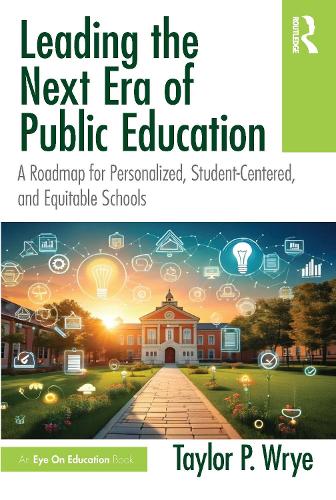
Leading the Next Era of Public Education
A Roadmap for Personalized, Student-Centered, and Equitable Schools Presenting a comprehensive framework for transforming any school or district in our rapidly evolving, technology-rich world, this book offers a practical roadmap for executive leaders, governing bodies, and school-level teams seeking to transition from incremental fixes to system redesign. Leading the Next Era of Public Education presents a comprehensive framework for transforming any school or district in our rapidly evolving, technology-rich world. Cognitive bias, institutional routines, and compliance cultures keep schools tied to what is familiar over what is effective. Are these legacy structures effectively serving teachers and students in the age of artificial intelligence (AI) and extended reality (XR)? This book offers a practical roadmap for executive leaders, governing bodies, and school-level teams seeking to transition from incremental fixes to system redesign. The book aligns strategy, operations, and instruction to support districts in delivering equitable, student-centered outcomes. Chapters include a wealth of fresh ideas in the following areas: Readers will leave with a coherent, implementable vision for an adaptive, equitable, student-centered public education system that replaces legacy structures that no longer serve all learners and prioritizes mastery, agency, and well-being.
Original: $70.80
-65%$70.80
$24.78Product Information
Product Information
Shipping & Returns
Shipping & Returns
Description
A Roadmap for Personalized, Student-Centered, and Equitable Schools Presenting a comprehensive framework for transforming any school or district in our rapidly evolving, technology-rich world, this book offers a practical roadmap for executive leaders, governing bodies, and school-level teams seeking to transition from incremental fixes to system redesign. Leading the Next Era of Public Education presents a comprehensive framework for transforming any school or district in our rapidly evolving, technology-rich world. Cognitive bias, institutional routines, and compliance cultures keep schools tied to what is familiar over what is effective. Are these legacy structures effectively serving teachers and students in the age of artificial intelligence (AI) and extended reality (XR)? This book offers a practical roadmap for executive leaders, governing bodies, and school-level teams seeking to transition from incremental fixes to system redesign. The book aligns strategy, operations, and instruction to support districts in delivering equitable, student-centered outcomes. Chapters include a wealth of fresh ideas in the following areas: Readers will leave with a coherent, implementable vision for an adaptive, equitable, student-centered public education system that replaces legacy structures that no longer serve all learners and prioritizes mastery, agency, and well-being.