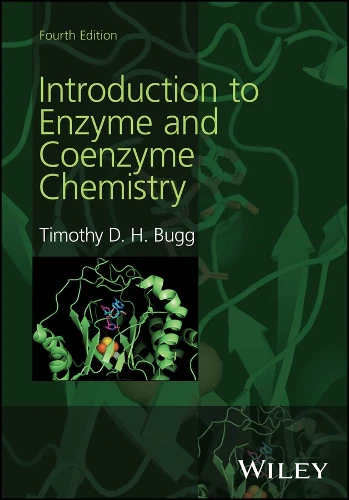
Introduction to Enzyme and Coenzyme Chemistry
A comprehensive, up-to-date discussion of what enzymes are, how they work, and how they catalyse enzymatic reactions Enzymes are giant macromolecules which catalyse all the biochemical reactions in living cells. Their three-dimensional structures are highly complex, yet they are formed by spontaneous folding of a linear polypeptide chain. Their catalytic properties are even more impressive than synthetic catalysts which operate under more extreme conditions. Enzyme-catalysed reactions proceed very high enantioselectivity and enantiospecificity at rates which approach “catalytic perfection.” Living cells carry out a huge repertoire of enzyme-catalysed chemical reactions, some of which have little or no precedent in organic chemistry. The popular textbook Introduction to Enzyme and Coenzyme Chemistry has been thoroughly updated with information on the most recent advances in our understanding of enzyme action. This newly revised fourth edition includes: Introduction to Enzyme and Coenzyme Chemistry provides a concise but comprehensive account from the perspective of organic chemistry that explains what enzymes are, how they work, and how they catalyse many of the major classes of enzymatic reactions. It will prove invaluable to undergraduate and postgraduate students of organic, bio-organic and medicinal chemistry, chemical biology, biochemistry and biotechnology.
Original: $106.21
-65%$106.21
$37.17Product Information
Product Information
Shipping & Returns
Shipping & Returns
Description
A comprehensive, up-to-date discussion of what enzymes are, how they work, and how they catalyse enzymatic reactions Enzymes are giant macromolecules which catalyse all the biochemical reactions in living cells. Their three-dimensional structures are highly complex, yet they are formed by spontaneous folding of a linear polypeptide chain. Their catalytic properties are even more impressive than synthetic catalysts which operate under more extreme conditions. Enzyme-catalysed reactions proceed very high enantioselectivity and enantiospecificity at rates which approach “catalytic perfection.” Living cells carry out a huge repertoire of enzyme-catalysed chemical reactions, some of which have little or no precedent in organic chemistry. The popular textbook Introduction to Enzyme and Coenzyme Chemistry has been thoroughly updated with information on the most recent advances in our understanding of enzyme action. This newly revised fourth edition includes: Introduction to Enzyme and Coenzyme Chemistry provides a concise but comprehensive account from the perspective of organic chemistry that explains what enzymes are, how they work, and how they catalyse many of the major classes of enzymatic reactions. It will prove invaluable to undergraduate and postgraduate students of organic, bio-organic and medicinal chemistry, chemical biology, biochemistry and biotechnology.