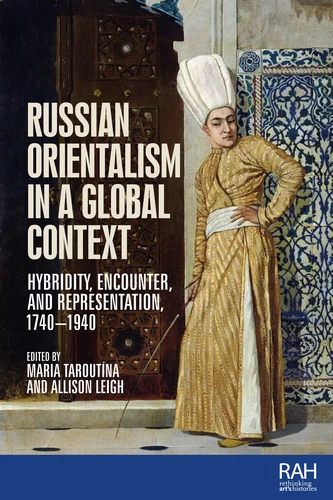
Russian Orientalism in a Global Context
Hybridity, Encounter, and Representation, 1740–1940
This volume features new research by an international group of scholars on Russia’s historic relationship with Asia and the ways in which it was mediated and represented in the fine, decorative, and performing arts and architecture from the mid-eighteenth century to the first two decades of Soviet rule.
This volume features new research on Russia’s historic relationship with Asia and the ways it was mediated and represented in the fine, decorative and performing arts and architecture from the mid-eighteenth century to the first two decades of Soviet rule. It interrogates how Russia’s perception of its position on the periphery of the west and its simultaneous self-consciousness as a colonial power shaped its artistic, cultural and national identity as a heterogenous, multi-ethnic empire. It also explores the extent to which cultural practitioners participated in the discursive matrices that advanced Russia’s colonial machinery on the one hand and critiqued and challenged it on the other, especially in territories that were themselves on the fault lines between the east and the west.
Original: $69.44
-65%$69.44
$24.30Product Information
Product Information
Shipping & Returns
Shipping & Returns
Description
Hybridity, Encounter, and Representation, 1740–1940
This volume features new research by an international group of scholars on Russia’s historic relationship with Asia and the ways in which it was mediated and represented in the fine, decorative, and performing arts and architecture from the mid-eighteenth century to the first two decades of Soviet rule.
This volume features new research on Russia’s historic relationship with Asia and the ways it was mediated and represented in the fine, decorative and performing arts and architecture from the mid-eighteenth century to the first two decades of Soviet rule. It interrogates how Russia’s perception of its position on the periphery of the west and its simultaneous self-consciousness as a colonial power shaped its artistic, cultural and national identity as a heterogenous, multi-ethnic empire. It also explores the extent to which cultural practitioners participated in the discursive matrices that advanced Russia’s colonial machinery on the one hand and critiqued and challenged it on the other, especially in territories that were themselves on the fault lines between the east and the west.