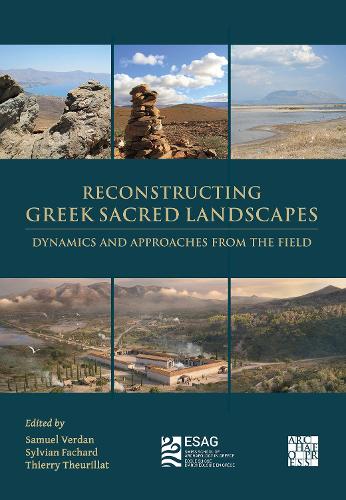
Reconstructing Greek Sacred Landscapes
Dynamics and Approaches from the Field What is meant by “sacred landscape”? How can ancient sacred landscapes, greatly eroded by time, be reconstructed? In the landscape, how did the religious dimension relate to the economic, social and political dimensions? In this book, scholars with many years’ experience of archaeological approaches to Greek religion offer answers to these questions, by presenting a variety of case studies. The examples selected relate to various regions of the Greek world (Attica, Arcadia, Boeotia, Euboea, Asia Minor) and the periods covered range from the Late Bronze Age to the Byzantine era. Several chapters are based on survey data, which are examined in relation to written sources. Topics covered include the development of sacred landscapes over the long term and the integration of major sanctuaries into their wider environment (Olympia, Kalapodi, Artemision at Amarynthos). The contributions reveal different understandings of a sacred landscape. As a modern concept, the latter is examined in a methodological introductory chapter. Two recent ethnographic examples, one from Morocco and the other from India, provide further food for thought. The book is intended as an incentive to exploit the heuristic potential of the concept of sacred landscape, while defining its boundaries.
Scholars with experience in Greek religious studies present different ideas on various questions about sacred landscapes in context and their reconstruction. With examples covering various regions of the Greek world and various time periods this book covers topics such as the development of these landscapes, their integration and their definition.
Product Information
Product Information
Shipping & Returns
Shipping & Returns
Description
Dynamics and Approaches from the Field What is meant by “sacred landscape”? How can ancient sacred landscapes, greatly eroded by time, be reconstructed? In the landscape, how did the religious dimension relate to the economic, social and political dimensions? In this book, scholars with many years’ experience of archaeological approaches to Greek religion offer answers to these questions, by presenting a variety of case studies. The examples selected relate to various regions of the Greek world (Attica, Arcadia, Boeotia, Euboea, Asia Minor) and the periods covered range from the Late Bronze Age to the Byzantine era. Several chapters are based on survey data, which are examined in relation to written sources. Topics covered include the development of sacred landscapes over the long term and the integration of major sanctuaries into their wider environment (Olympia, Kalapodi, Artemision at Amarynthos). The contributions reveal different understandings of a sacred landscape. As a modern concept, the latter is examined in a methodological introductory chapter. Two recent ethnographic examples, one from Morocco and the other from India, provide further food for thought. The book is intended as an incentive to exploit the heuristic potential of the concept of sacred landscape, while defining its boundaries.
Scholars with experience in Greek religious studies present different ideas on various questions about sacred landscapes in context and their reconstruction. With examples covering various regions of the Greek world and various time periods this book covers topics such as the development of these landscapes, their integration and their definition.