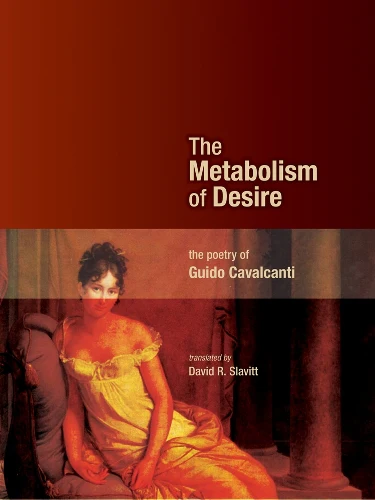
The Metabolism of Desire
The Poetry of Guido Cavalcanti all pale beside my lady whose lovelyface ciò passa la beltate e la valenza and gentle heart show theunworthiness de la mia donna e 'l su' gentil coraggio, of him who catches a glimpse of herperfection, sì che rasembra vile a chi ciò guarda; for she is an earthly vessel of heaven'sgrace e tanto più d'ogn' altr' ha canoscenza, before whose greatness we are so muchless, quanto lo ciel de la terra è maggio. beyond any redemption or evencorrection. A simil di natura ben non tarda. The fact that Cavalcanti's friend, Dante Alighieri, was asupremely fine poet ought not blind us to Cavalcanti's own, ratherdifferent excellence. His love poetry has more of the tang ofreal-world experience and is as appealing as Dante's, although in amore modern and recognizable way. The two poets both suffer, butCavalcanti is not so sure that his torments are likely to improve hisspirit. He is, therefore, more torn and under greater pressure to findsome meaning in his struggles, and, as translator David R. Slavittdeclares, "more fun."
Bringing his genuine poetic gifts to the project, Slavitt's translations provide stronger evidence of the originals' poetic qualities than has been available for at least a century. - Henry Taylor, Pulitzer Prize winner
Original: $27.22
-65%$27.22
$9.53Product Information
Product Information
Shipping & Returns
Shipping & Returns
Description
The Poetry of Guido Cavalcanti all pale beside my lady whose lovelyface ciò passa la beltate e la valenza and gentle heart show theunworthiness de la mia donna e 'l su' gentil coraggio, of him who catches a glimpse of herperfection, sì che rasembra vile a chi ciò guarda; for she is an earthly vessel of heaven'sgrace e tanto più d'ogn' altr' ha canoscenza, before whose greatness we are so muchless, quanto lo ciel de la terra è maggio. beyond any redemption or evencorrection. A simil di natura ben non tarda. The fact that Cavalcanti's friend, Dante Alighieri, was asupremely fine poet ought not blind us to Cavalcanti's own, ratherdifferent excellence. His love poetry has more of the tang ofreal-world experience and is as appealing as Dante's, although in amore modern and recognizable way. The two poets both suffer, butCavalcanti is not so sure that his torments are likely to improve hisspirit. He is, therefore, more torn and under greater pressure to findsome meaning in his struggles, and, as translator David R. Slavittdeclares, "more fun."
Bringing his genuine poetic gifts to the project, Slavitt's translations provide stronger evidence of the originals' poetic qualities than has been available for at least a century. - Henry Taylor, Pulitzer Prize winner