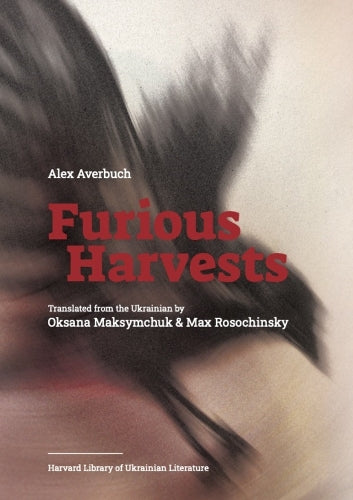
Furious Harvests
Furious Harvests, a collection of striking poetry by Alex Averbuch, explores existential questions that war raises: from the Russian aggression against Ukraine currently taking place in Averbuch’s home region of Luhansk, to the events of World War II, including poems that incorporate historical letters of Jewish Holocaust survivors.
Furious Harvests transports readers to Alex Averbuch’s homeland of eastern Ukraine. Amid the bloody destruction brought by Russia’s war of aggression, the poet toils in fields of memory, reaping lyrics from family archives and mementos to amass testaments to the complex and painful histories of this place and its peoples. A family tree, letters to home, and the faint scent of a grandmother’s dress kept in the back of a closet speak to histories of inter-ethnic violence, WWII forced laborers, and the Holocaust. Mixing dialects, styles, registers, and voices, Furious Harvests—presented in a bilingual edition—defiantly cries out in its rage and longing toward reconciliation of the self and other.
Product Information
Product Information
Shipping & Returns
Shipping & Returns
Description
Furious Harvests, a collection of striking poetry by Alex Averbuch, explores existential questions that war raises: from the Russian aggression against Ukraine currently taking place in Averbuch’s home region of Luhansk, to the events of World War II, including poems that incorporate historical letters of Jewish Holocaust survivors.
Furious Harvests transports readers to Alex Averbuch’s homeland of eastern Ukraine. Amid the bloody destruction brought by Russia’s war of aggression, the poet toils in fields of memory, reaping lyrics from family archives and mementos to amass testaments to the complex and painful histories of this place and its peoples. A family tree, letters to home, and the faint scent of a grandmother’s dress kept in the back of a closet speak to histories of inter-ethnic violence, WWII forced laborers, and the Holocaust. Mixing dialects, styles, registers, and voices, Furious Harvests—presented in a bilingual edition—defiantly cries out in its rage and longing toward reconciliation of the self and other.