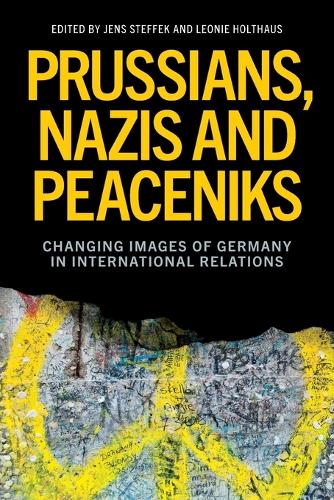
Prussians, Nazis and Peaceniks
Changing Images of Germany in International Relations Germany looms large in international politics, far larger than its size and population would suggest. From images of Prussian militarism, to the Holocaust, the Nuremberg trials, and the fall of the Berlin Wall, changing perceptions of Germany in the twentieth century not only determined how Germans were seen and treated, but they influenced the concepts that scholars and practitioners used to theorise international relations in the English-speaking world. Today, ‘civil power’ Germany, an economic giant but a military dwarf, is seen as a puzzling aberration from normal state behaviour.
In this book, historians and political scientists show how radically external images of Germany changed over the 20th century, from the ‘Prussian military state’ to the ‘bulwark of liberalism.’ They also explore how such images of Germany affected the evolution of international relations theory at some critical junctures.
Situated at the intersection of International Relations and international history, Prussians, Nazis and Peaceniks examines external perceptions of Germany and their implications for international theory. At crucial moments in the development of these disciplines, scholars cited Germany in debates on the nature and mechanisms of international politics: liberal internationalists contrasted cooperative foreign policies with an inherently aggressive ‘Prussianism,’ early realists looked to German revisionism and its fight against the Treaty of Versailles, and in the United States, German émigré scholars translated historical experiences into social-scientific vocabularies.
The changing images of Germany in debates in International Relations demonstrate that it is not just the nation-state we often perceive it to be. Rather, Germany continues to be a contestable concept: a political construct that is both contingent and in constant flux.
Original: $54.46
-65%$54.46
$19.06Product Information
Product Information
Shipping & Returns
Shipping & Returns
Description
Changing Images of Germany in International Relations Germany looms large in international politics, far larger than its size and population would suggest. From images of Prussian militarism, to the Holocaust, the Nuremberg trials, and the fall of the Berlin Wall, changing perceptions of Germany in the twentieth century not only determined how Germans were seen and treated, but they influenced the concepts that scholars and practitioners used to theorise international relations in the English-speaking world. Today, ‘civil power’ Germany, an economic giant but a military dwarf, is seen as a puzzling aberration from normal state behaviour.
In this book, historians and political scientists show how radically external images of Germany changed over the 20th century, from the ‘Prussian military state’ to the ‘bulwark of liberalism.’ They also explore how such images of Germany affected the evolution of international relations theory at some critical junctures.
Situated at the intersection of International Relations and international history, Prussians, Nazis and Peaceniks examines external perceptions of Germany and their implications for international theory. At crucial moments in the development of these disciplines, scholars cited Germany in debates on the nature and mechanisms of international politics: liberal internationalists contrasted cooperative foreign policies with an inherently aggressive ‘Prussianism,’ early realists looked to German revisionism and its fight against the Treaty of Versailles, and in the United States, German émigré scholars translated historical experiences into social-scientific vocabularies.
The changing images of Germany in debates in International Relations demonstrate that it is not just the nation-state we often perceive it to be. Rather, Germany continues to be a contestable concept: a political construct that is both contingent and in constant flux.